Police violence & public voiceFailedJuly 2024 · May 2026
She called Lewis family supporters “bullies, terrorists, anarchists.”
CPR News documented Hancock’s words about supporters who sought answers after an officer shot Kilyn Lewis. She later voted to reopen in-person meetings in July 2025. In May 2026 she voted against a mourning resolution that passed 7–3.
Our assessment A council member can disagree with a protest and still acknowledge a family’s loss. Both her language and her vote fell short of that standard.
Trump & immigrationFailedOctober 2024 · January 2026
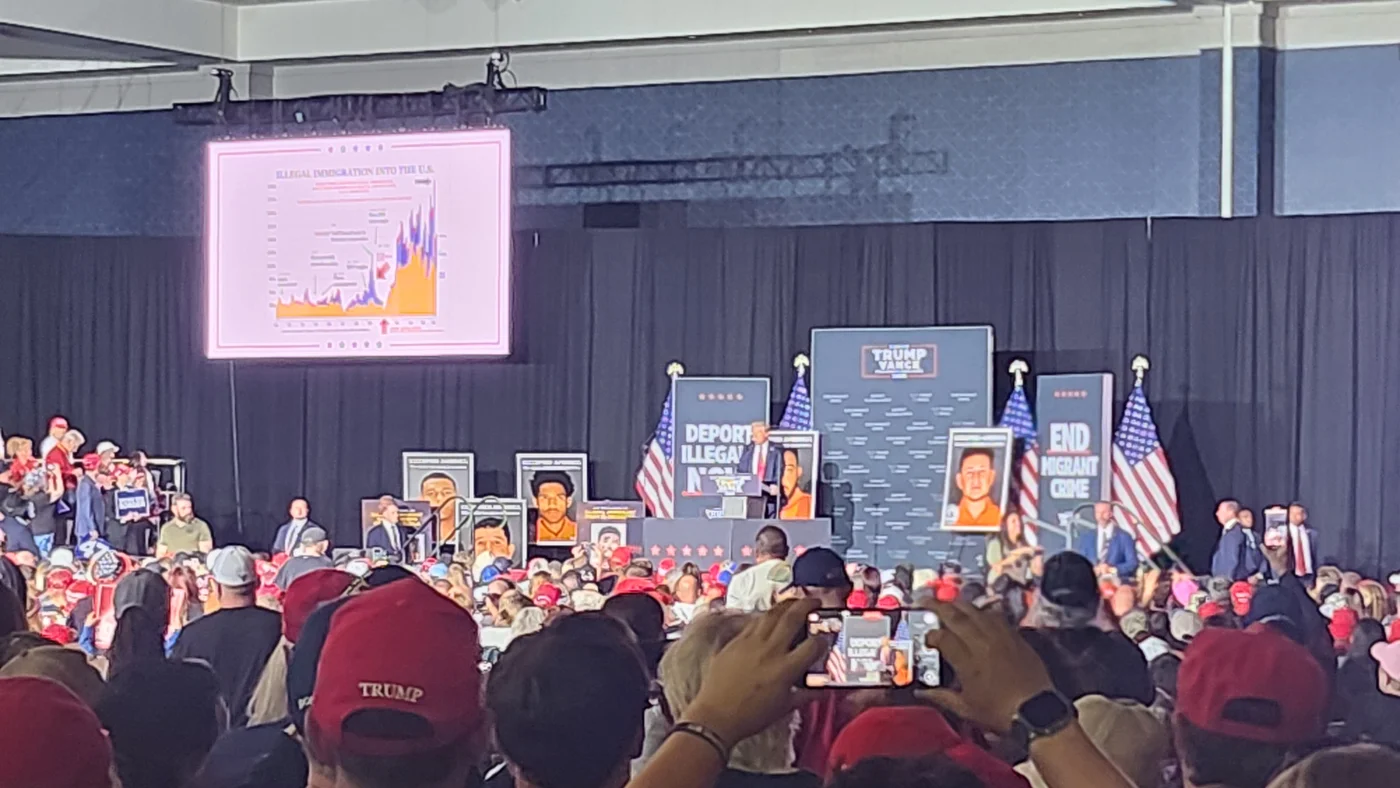
Trump recognized her at his Aurora rally.
Trump named Hancock and Jurinsky from the stage where he announced Operation Aurora. In January 2026 Hancock voted against Aurora’s resolution opposing federal immigration enforcement overreach. The measure passed 6–4.
Our assessment The local vote shows what she did when residents asked the city to take a stand. Trump’s acknowledgment is separately documented in his own remarks.
She voted against returning the pause to the floor.
Hancock opposed reconsideration after more than 50 people signed up to speak in favor of a pause. Seven votes were needed and six supported reopening debate. She could have requested reconsideration on November 9 and did not. A narrower pause sponsored by the full council was on the November 23 agenda. It would cover much of the city and exempt the pending Trident project.
Our assessment Ward IV residents deserve an explanation for closing debate while the city was still writing rules about where these facilities could go.
Hancock helped remove the expiration date on mandatory jail for retail theft.
Hancock voted yes. The council adopted ordinance 2024-62 by seven votes to two. In September 2026 a unanimous council repealed municipal mandatory minimums after state Supreme Court decisions limited how cities could punish conduct also covered by state law.
Our assessment A mandatory sentence takes discretion away from the judge hearing the facts. This vote extended that policy beyond its scheduled expiration, and a later council had to revisit it.
Aurora sent other cities a warning about bringing people here.
Hancock backed the resolution. It objected to the organized transport of migrants and unhoused people for temporary shelter without first giving Aurora an opportunity to coordinate. The city attorney said the resolution had no enforcement mechanism.
Our assessment Coordination between cities matters. For a family looking for a room, this council action specified what it wanted neighboring cities to stop doing and offered no place for the family to stay.
A vote against limits on posting suspects’ names and photos.
Hancock voted against the final police communications measure. It restricted identifying people publicly before conviction and allowed an exception for an active threat to public safety. The measure passed.
Our assessment Being named by a police department can affect someone’s job or reputation before a court hears the case. We grade the vote against that protection as a failure.
She cast the only no vote on support for documented immigrants.
Council adopted a statement backing documented immigrant residents, including neighbors who relied on temporary federal protections. Hancock was the lone opponent in the 9–1 vote. Gardner was absent.
Our assessment Even after the council narrowed the statement to documented residents, Ward IV’s representative declined to join it. Families facing uncertainty deserved a public assurance from their own city.
The city’s human-relations commission faced elimination.
Hancock spoke in support of Jurinsky’s case for eliminating the Human Relations Commission. Commissioners disputed allegations that their board had sponsored a partisan event. The council ultimately postponed the decision at that meeting.
Our assessment A resident bringing a discrimination concern to City Hall has a stake in whether this commission exists. We fault the effort to close it while commissioners were still answering the accusations.
Hancock voted to confirm Chamberlain after the family asked to be heard.
Ward IV’s representative voted yes. A month earlier, LaRonda Jones had come to Hancock’s town hall seeking accountability for her son’s death. In August, Jones and other family members joined residents protesting a chief selection made without prior public input.
Our assessment We fault the vote to proceed after residents asked for a say in selecting the person who would oversee use of force and officer discipline. The city manager made the selection. Council had the power to withhold confirmation.
Hancock seconded Bergan’s motion and voted for the rule. The rule generally limited the podium to one person, with exceptions for a guardian accompanying a minor, an interpreter or a person needing disability assistance.
Our assessment Relatives and neighbors had stood together while one person spoke. For someone testifying about a death in the family, an ally at their shoulder matters even when that ally never says a word.